
The Friche Josaphat: from rail yard to wild meadow, and what happens next
Between Schaerbeek and Evere, behind the houses of Terdelt and avenue Gustave Latinis, lies one of the largest open spaces in Brussels. About 25 hectares of grass, scrub and sand, crossed by railway line 26. Locals call it the Friche Josaphat. Here is its story, from the first trains to the decisions of October 2026.

A rail yard for almost seventy years
The Schaerbeek-Josaphat freight station opened on 19 July 1926, the same day as railway line 26 between Schaerbeek and Watermael. Around it, the Terdelt garden city was taking shape. For decades, freight wagons were sorted here on the edge of a quickly growing city.
The yard closed in 1994 and the tracks were removed. On 25 April 2006, the Brussels-Capital Region bought around 25 hectares from the railway infrastructure fund, through its land company SAF. That company is now the SAU (Société d'aménagement urbain), which still owns the site today.
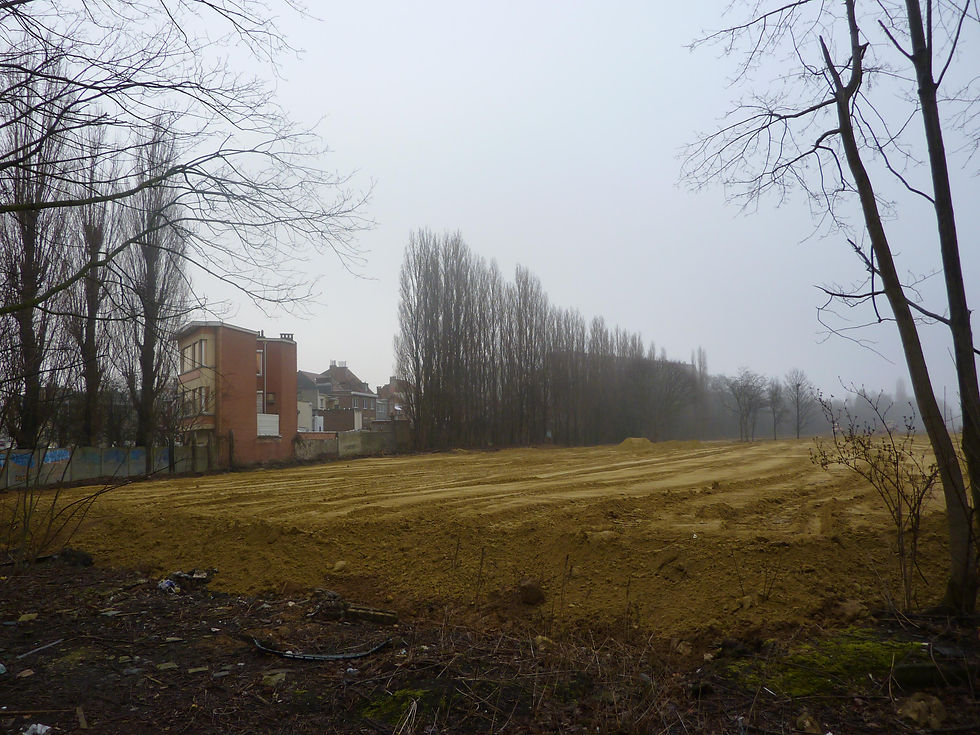
A young meadow that nature took back
What many people do not know: the green landscape you see today is recent. In 2013, the site was cleaned up and levelled with soil and sand. Then, with almost no human intervention, nature moved in.
The result surprised scientists. A study led by ULB researchers, combining five years of citizen observations and field surveys (2015 to 2020), recorded 127 species of wild bees on the site. That is about 60% of all bee species ever recorded in the Brussels Region, and roughly a third of Belgium's bee species, on a single former rail yard.
Nine of those species are threatened at Belgian or European level. One of them, the seven-spined woolcarder bee (Anthidium septemspinosum), had never been recorded in Belgium before it was found here. Several other species are known in Brussels only from this site.
Bees are not alone. By the end of 2020, naturalists had logged more than 1,100 species on observations.be, including 114 bird species, 33 butterflies and 32 dragonflies and damselflies. Brussels lies under several bird migration routes, and the open grassland offers a rare stopover in a dense city. The researchers also point to the sunny railway embankments, with their bare soil and flowers, as one reason for this richness.

Big plans for a strategic site
For the Region, Josaphat has long been a strategic site to answer the demand for housing, jobs and public facilities. In the regional land-use plan (PRAS), part of it is a "zone of regional interest" (ZIR 13), and part is reserved for urban industry.
In 2019, a first master plan, the PAD Josaphat, went to public inquiry. It planned around 1,600 homes on the whole site. A revised version followed in 2021, with a second public inquiry. The PAD was never finally approved by the Brussels government.
In parallel, the SAU chose a private consortium, Eiffage-AXA, to develop a first phase. In 2023, it filed a subdivision permit application (permis de lotir) for "Phase 1A": the south-east part of the site, about 6.7 hectares. Bruxelles Environnement classifies this zone as having a very high biological value.
A growing citizen movement
Since the first plans, residents, naturalists and associations have asked for the site to be protected. Groups such as Sauvons la Friche Josaphat, Natagora, Brussel Natuur-Bruxelles Nature, BRAL, IEB, ARAU and We Are Nature have taken part in every public inquiry.
Each inquiry has drawn more reactions than the last. In 2025, the commune of Schaerbeek abstained from giving an opinion. In 2026, the amended Phase 1A application drew close to 15,000 objections.
2025–2026: a court ruling and a freeze
Two events changed the context.
29 October 2025: in a case brought by We Are Nature, the French-speaking court of first instance in Brussels ordered the Region to suspend the urbanisation of unbuilt sites larger than 0.5 hectares, until a new PRAS is adopted or until 31 December 2026. The court found the current plans no longer reflect today's climate and biodiversity needs. The Region has appealed.
13 February 2026: the new Brussels government's policy declaration announced an 18-month freeze on the development of four sites: Josaphat, Meylemeersch, Keyenbempt and Bois du Calevoet. The files will be reviewed at the end of that period.
The permit procedure itself continued. Audrey Henry, Brussels Secretary of State for Urbanism, has stated that no permit will be issued during the freeze.
The latest news (October 2026)
From 28 August to 26 September 2026, an amended version of the Phase 1A project went to public inquiry. It covers 6.76 hectares, with up to 537 homes, 8,560 m² for economic activities and facilities, 391 underground parking spaces and 3.14 hectares of public green space (about 46% of the perimeter).
On 6 October 2026, Schaerbeek's college of mayor and aldermen gave an unfavourable opinion on the project, by majority. It considers that the changes do not answer concerns about heat islands, rainwater management, soil and biodiversity, and the project's integration into the commune. Mayor Martin de Brabant said the mobilisation around the Friche "deserves to be heard".
Next step: the concertation commission meets on 12 October 2026 at Schaerbeek town hall. The commune's opinion is advisory. The final decision on the permit lies with the Region.
Did you know?
The name is 450 years old. According to tradition, a pilgrim back from the Holy Land in 1574 found that the valley looked like the Valley of Josaphat. The name later went to Parc Josaphat, opened in 1904, and today to the whole area, including the friche.
A rail yard in disguise. The meadow only exists in its current form since 2013, and line 26 still runs through it.
A first for Belgium. The seven-spined woolcarder bee was first recorded in Belgium here.
Public access. In summer 2020, a temporary park opened on part of the site, with an entrance on avenue Gustave Latinis.
Follow the file
The Friche Josaphat is about housing, climate, nature and how Brussels wants to grow. Whatever happens next, it is worth knowing the place. Walk along its edges, look at the embankments in spring, and follow the next steps of the procedure on the commune's and the Region's websites.
Photo credits
Friche Josaphat, 26 November 2020. Photo: Bruxelles1030, Wikimedia Commons, CC BY-SA 4.0. (Wikimedia Commons)
Former Schaerbeek-Josaphat station, 2012. Photo: Lumixbx, Wikimedia Commons, CC BY-SA 3.0. (Wikimedia Commons)
Seven-spined woolcarder bee (Anthidium septemspinosum), illustrative photo not taken at the Friche. Photo: Karim Strohriegl, Wikimedia Commons, CC BY 4.0. (Wikimedia Commons)
Sources
Vereecken N. J. et al., "Five years of citizen science and standardized field surveys reveal a threatened urban Eden for wild bees in Brussels", bioRxiv, 2021
perspective.brussels, PAD Josaphat, informative section
Wikipedia, "Josaphat Brownfield", "Belgian railway line 26", "Josaphat Park"
ARAU, press release, 5 October 2026
La Libre, 28 August and 16 September 2026; L'Avenir, 16 September and 6 October 2026; BX1, 6 October 2026
Stibbe, analysis of the Brussels government agreement, 20 February 2026


Comments